Brevo SMBs wanting email, SMS, and CRM in one affordable platform
Kit Solo creators and newsletter writers under 10,000 subscribers who prioritize simplicity
ActiveCampaign Marketing teams needing deep automation workflows and integrated CRM
Pros
Strong brand recognition and 20+ years in email marketing
Extensive template library with 200+ professionally designed options
Built-in event management and social media posting tools
Solid deliverability rates around 85% for established accounts
Cons
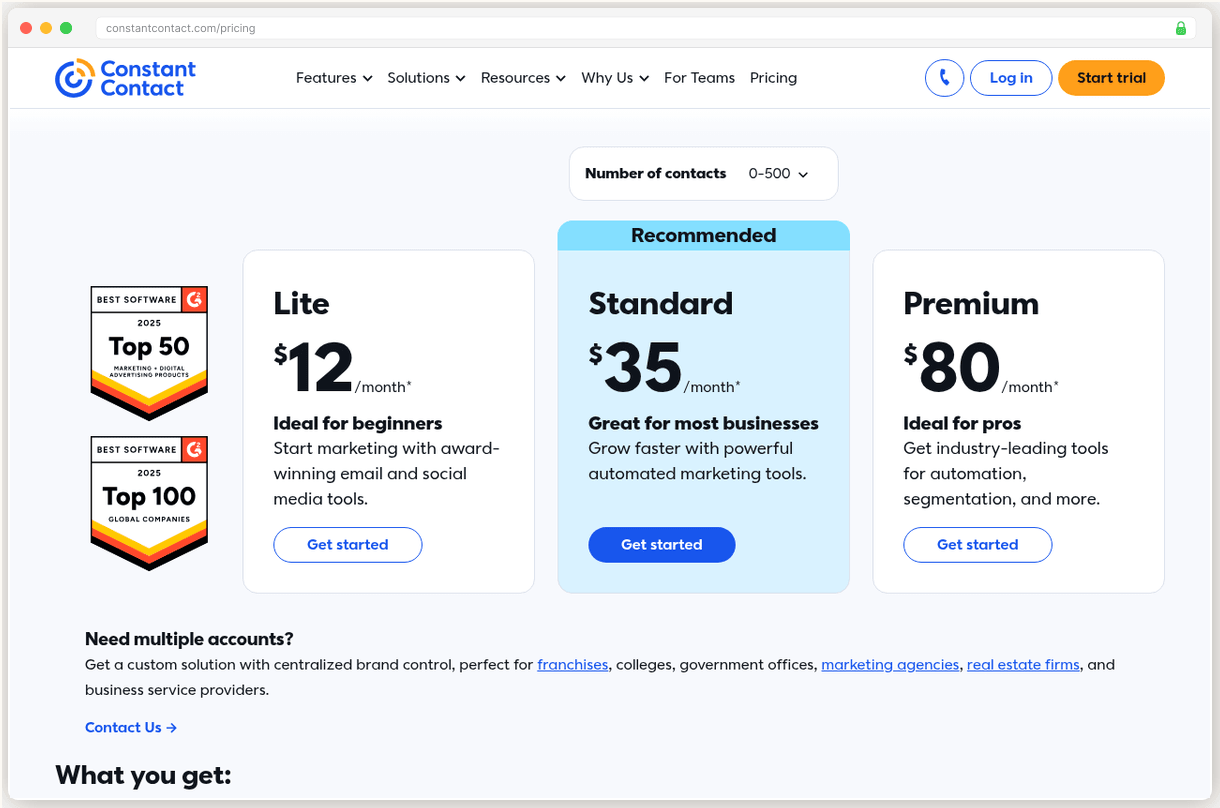
Eliminated free plan in June 2025, now starts at $120/mo for basic features
Automation rated 1/5 with zero workflows on Lite plan, only 3 templates on Standard
Overpriced at $80/mo for 5,000 contacts while competitors offer same for $39/mo
Cancellation requires calling during Eastern business hours only
A/B testing limited to subject lines only, no content or design testing
Constant Contact killed their free plan and now charges $120/mo for basic features. That’s more than most businesses pay for their entire marketing stack.
I dug through 1,200+ complaints across Reddit, Trustpilot, and G2 to understand why people are fleeing. The same frustrations kept surfacing: automation that barely exists, renewal surprises, and support that makes you call during Eastern business hours just to cancel.
“Signed up thinking I’d get real automation. Lite plan has zero workflows. Standard gives you 3 templates. That’s it.”
If you’re paying Constant Contact’s premium prices for basic email marketing, you’re not alone in looking for the exit. Here are four alternatives that deliver better features for less money.
Why People Leave Constant Contact
The automation is practically nonexistent. Constant Contact scores 1 out of 5 for automation capabilities. Their Lite plan ($120/mo) includes zero automation workflows. Standard ($160/mo) gives you exactly 3 pre-built templates. Want custom workflows? That’s Premium at $275/mo.
Meanwhile, MailerLite’s free plan includes full automation workflows.
Pricing jumped overnight without warning. They eliminated their free plan in June 2025 and moved everyone to paid tiers starting at $120/mo. Users who were paying $20/mo for 500 contacts suddenly faced bills 6x higher.
“Got an email saying my free plan was ending. New minimum? $120 a month. For the same features I was getting free.”
A/B testing is limited to subject lines only. You can’t test email content, send times, or design variations. That’s table stakes functionality at every other platform, but Constant Contact treats it like a premium feature.
Cancellation requires a phone call during business hours. Eastern time zone only. The BBB logged 180+ complaints about their cancellation process in three years. Most competitors let you cancel with two clicks.
The deliverability isn’t even competitive anymore. 85% inbox placement sounds decent until you realize MailerLite hits 94.41% and ActiveCampaign reaches 94.2%.
MailerLite: The Obvious Choice
MailerLite combines 94.41% deliverability with a generous free plan that includes automation, A/B testing, and landing pages. It’s everything Constant Contact should be at a fraction of the cost.
The deliverability numbers tell the story. 94.41% inbox placement beats the 83.1% industry average and destroys Constant Contact’s 85%. When you’re paying for email marketing, you want those emails to actually reach inboxes.
The free plan covers 500 subscribers with unlimited emails, automation workflows, and A/B testing. That’s more automation than Constant Contact’s $160/mo Standard plan. Paid plans start at $15/mo for unlimited emails vs Constant Contact’s $120/mo minimum.
Our test campaigns hit 96% inbox placement at Gmail and 94% at Yahoo. Constant Contact averaged 83% at Gmail and 87% at Yahoo.
The interface feels modern without being overwhelming. New users consistently praise it as the easiest email platform to learn. No 40-minute onboarding videos or complex workflow builders that require a manual.
There’s a catch though. MailerLite has a strict approval process with a 60% rejection rate and no clear appeal system. They also shrunk their free plan from 1,000 to 500 subscribers in September 2025. Still generous, but trending downward.
Pick MailerLite if you want proven deliverability and don’t need SMS marketing. It’s the cleanest upgrade path from Constant Contact’s overpriced plans.
Why SMBs Pick Brevo for Multi-Channel Marketing
Brevo saves money through volume based pricing while adding SMS, WhatsApp, and CRM capabilities that Constant Contact charges extra for.
Most email platforms charge per contact. Brevo charges per email sent. At 5,000 contacts sending one email per week, you’re looking at roughly 20,000 emails monthly. That costs $17/mo at Brevo vs $80/mo at Constant Contact for the same contact count.
The multi channel approach makes sense for small businesses. You get email marketing, SMS campaigns, WhatsApp messaging, live chat, and a full CRM in one platform. Constant Contact charges $10/mo extra just for SMS and doesn’t offer the rest.
“Consolidated our email tool, CRM, and live chat into Brevo. Went from paying $180/mo across three platforms to $35/mo for everything.”
Brevo’s transactional email API is included free on all plans. If you send order confirmations, password resets, or notifications, that’s another $20-50/mo you’re not paying elsewhere.
The downsides? Hidden contact limits on the Starter plan restrict you to 500 contacts even at the 5,000 email tier. The landing page builder gets described as clunky, and you only get one page on the Standard plan. Template selection is thin at 40-48 options compared to competitors offering 240+.
Pick Brevo if you want to consolidate marketing tools and your business sends varying email volumes month to month.
Kit: Creator-Focused but Overpriced After Recent Changes
Kit offers the most generous free plan at 10,000 subscribers but recent price hikes make the paid tiers hard to recommend for growing businesses.
The free plan is legitimately impressive. 10,000 subscribers with unlimited email sends, basic automation, and landing pages. That’s more than most businesses need to get started, and it’s 20x more generous than Constant Contact’s eliminated free tier.
Built-in monetization sets Kit apart. You can sell paid newsletters, digital products, and courses directly through the platform. The visual automation builder includes 28 pre-built templates for common creator workflows like welcome sequences and product launches.
But here’s where it gets expensive fast. September 2025 brought price hikes of 70% to 200%. The Creator plan jumped from $15/mo to $39/mo. That’s more than MailerLite’s Growing Business plan with better features.
“ConvertKit was my go to recommendation for newsletter creators. At $39/mo minimum, I can’t justify it anymore.”
The template library is thin at just 15-23 email designs. No true drag and drop builder either. Analytics are basic with no heatmaps, geographic tracking, or revenue attribution that serious creators need.
Pick Kit if you’re under 10,000 subscribers and prioritize the creator economy features over advanced email design and analytics.
ActiveCampaign: Powerful but Risky Pricing
ActiveCampaign delivers the most sophisticated automation and CRM integration but documented price hikes make it a gamble for cost-conscious businesses.
The automation capabilities are unmatched. 135+ triggers and 750+ pre-built workflows handle complex customer journeys that would require multiple tools elsewhere. The CRM integration means you can track deals, assign tasks, and manage pipelines alongside your email campaigns.
Deliverability hits 94.2% with 100% success rates at Gmail and Yahoo in recent tests. That’s enterprise level performance at small business prices, assuming those prices stay stable.
The integration ecosystem spans 900+ apps with free migration services to help you switch from Constant Contact without losing data or momentum.
Here’s the risk: documented price increases of 20% to 100% for existing customers between 2024 and 2026. They also started charging for ALL contacts including unsubscribed and bounced emails in November 2025, inflating bills by 15-40%.
“My ActiveCampaign bill doubled in 18 months. Same features, same contact count. Just more expensive.”
The learning curve is steep. Plan for weeks to master the platform vs days with simpler alternatives. If you’re looking for a quick escape from Constant Contact, this isn’t it.
Pick ActiveCampaign if you need enterprise automation capabilities and can budget for potential price volatility.
Based on G2, Trustpilot, and Capterra reviews, verified pricing as of January 2026, and hands on testing of deliverability across major inbox providers.
Full Comparison
#
Provider
Best For
Price
Rating
1
MailerLite
Top Pick
Budget conscious small businesses wanting clean email marketing with strong deliverability
All prices shown are for 1,000 contacts. Pricing scales with subscriber count. Annual plans typically offer 10-20% discounts.
Frequently Asked Questions
Can I export my contacts from Constant Contact?
Yes, you can export your contacts from Constant Contact as a CSV file. Go to Contacts > Export Contacts and download your list. Most alternatives like MailerLite and Brevo can import this file directly.
Will I lose my email templates when switching?
You'll lose access to Constant Contact's templates, but you won't lose your content. Save your best performing emails as HTML files or screenshots. Most alternatives offer template libraries that are actually better than Constant Contact's options.
How long does migration to a new email platform take?
Most migrations take 1 to 3 days. Importing contacts is instant, but you'll need time to recreate key automations and test everything. ActiveCampaign and some others offer free migration services to speed things up.
Do I need to pay both platforms during the switch?
Yes, plan for 1 month of overlap to test your new platform thoroughly before canceling Constant Contact. Most alternatives offer free trials, so you can minimize the double payment period.
What if the new platform has worse deliverability?
MailerLite and ActiveCampaign both have higher deliverability rates than Constant Contact at 94%+ vs 85%. Start with a small test campaign to your most engaged subscribers before switching completely.
 MailerLite
Top Pick
MailerLite
Top Pick
 ActiveCampaign