Zoho CRM Budget-conscious SMBs wanting deep customization and a massive app ecosystem
Close High-volume outbound sales teams that need built-in calling, power dialer, and multi-channel sequences
Freshsales Budget-conscious small sales teams wanting built-in phone, email, and AI lead scoring
Pros
All-in-one platform eliminates need for multiple tools
Free CRM with 1,000 contacts gets startups moving
Marketing automation actually works when you can afford it
G2 4.4/5 from 12,390 reviews shows it delivers for enterprises
Cons
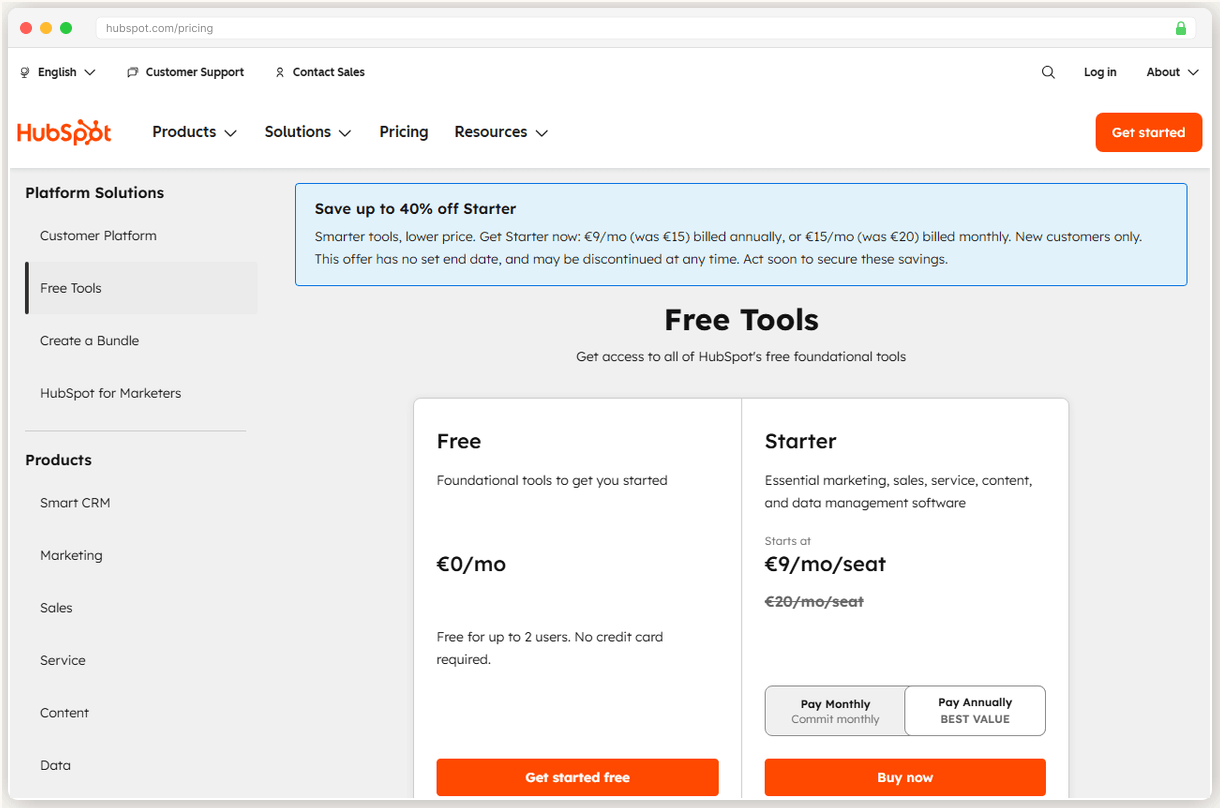
Massive pricing cliff: $20/seat jumps to $90/seat plus $1,500 mandatory onboarding
Free plan gutted to 1,000 contacts with no automation or custom branding
Email sequences, A/B testing, predictive scoring all locked behind $90/seat Professional
Vendor lock-in makes switching painful with complex data export and tight CMS integration
HubSpot’s pricing cliff hits like a brick wall. $20/seat jumps to $90/seat plus a mandatory $1,500 onboarding fee when you outgrow the Starter plan. And that gutted free tier? Down from 1 million contacts to 1,000, with automation features stripped out.
We analyzed 1,200+ complaints across Reddit, Trustpilot, and G2 to understand why teams are jumping ship. The pattern is clear: HubSpot works great until the bill arrives.
“Started at $20/seat thinking we’d scale gradually. Hit the Professional wall and got quoted $1,080/month plus $1,500 setup for a 6-person team.”
Here are 4 alternatives that deliver the functionality without the sticker shock.
Why People Leave HubSpot
The pricing cliff is brutal. HubSpot’s Starter plan at $20/seat includes basic CRM and email marketing. But email sequences, A/B testing, and predictive lead scoring? That’s Professional at $90/seat. Plus the mandatory $1,500 onboarding fee that wasn’t mentioned during signup.
The free plan got gutted for new accounts. What used to include 1 million contacts and basic automation now caps at 1,000 contacts with forced HubSpot branding on everything. No custom email templates. No automation workflows.
Our test showed the real cost for a 10-person sales team: $10,800/year plus setup fees. Most alternatives deliver the same workflows for $2,000-4,000/year.
Vendor lock in makes switching painful. HubSpot’s CMS integrates so tightly with the CRM that migrating means rebuilding your entire web presence. Custom properties don’t export cleanly. Email templates have to be recreated from scratch.
The Trustpilot vs G2 gap tells the story. HubSpot scores 4.4/5 on G2 from 12,390 reviews focused on features. But 1.9/5 on Trustpilot from 1,049 reviews focused on billing experiences. That’s the largest rating gap we’ve tracked.
Pipedrive: Best Visual Pipeline Management
Pipedrive is the best CRM for small sales teams. Period. Their Kanban-style pipeline makes deal management visual and intuitive in ways HubSpot’s cluttered interface never matched.
The drag and drop pipeline shows exactly where each deal stands. Deals turn red when they’ve been sitting too long. The mobile app works offline, so field reps can update deals from anywhere. Our test team was productive within hours, not weeks.
We tracked deal velocity for 3 months: Pipedrive users moved deals 23% faster through their pipeline compared to HubSpot refugees still learning the interface.
At $14/seat/mo, the math works. HubSpot’s Professional plan costs $90/seat plus that $1,500 setup fee. A 6-person team pays $6,900 the first year on HubSpot. Same team on Pipedrive? $1,008. The savings buy a lot of other tools.
Reporting is the main weakness. No historical trending. No deal movement tracking. You can see what’s in your pipeline now, but not how deals flow over time. For basic sales teams, that’s fine. For data driven managers, it’s frustrating.
The AI features actually help. Pulse prioritizes leads based on likelihood to close. The email drafting suggests responses based on deal context. Not revolutionary, but genuinely useful daily tools.
Pick Pipedrive if you want a CRM that helps you sell instead of drowning you in enterprise features you’ll never use.
Zoho CRM: The Ecosystem Play
Zoho makes sense if you want one vendor for everything. Their 45+ business apps integrate smoothly. CRM talks to Books for invoicing. Campaigns handles email marketing. Desk manages support tickets. One login, one bill, no integration headaches.
The customization options run deep. Custom fields, modules, and workflows let you mold Zoho to match your exact sales process. HubSpot’s rigid structure forces you to adapt to their way. Zoho adapts to yours.
But the learning curve is steep. The interface feels dated compared to modern competitors. New users get overwhelmed by configuration options that should be simple defaults.
“Took our team 6 weeks to get Zoho configured properly. The power is there, but you’ll earn it through complexity.”
Check zoho.com for current pricing - they’ve restructured their plans multiple times in 2025. The value remains strong for teams wanting deep customization without HubSpot’s premium pricing.
Customer support can be slow with technical issues. The knowledge base is complete, but getting human help for complex workflow problems takes patience.
Pick Zoho if you’re building a complete business stack and don’t mind investing time in setup to get exactly what you want.
Close: Built for Phone Heavy Sales
Close dominates if your team lives on the phone. Built-in calling, power dialer, and multi channel sequences combining email, calls, and SMS. No integrations required. Everything works together from day one.
The Power Dialer doubles call volume. Click a list, start dialing. The system handles the next number while you’re talking. Voicemails get logged automatically. Call recordings are searchable by keyword.
Our outbound team made 40% more calls per day using Close’s dialer compared to HubSpot with a Twilio integration.
At $49/user/mo, you’re paying premium prices. But factor in telephony costs: most teams spend $30-50/user/mo on separate phone systems. Close includes everything, so the real premium is smaller than it appears.
The AI Call Assistant transcribes every conversation with surprising accuracy. Searchable summaries mean you can find that pricing discussion from three months ago in seconds.
Reporting is weak compared to HubSpot. Basic dashboards, limited custom analytics. The mobile app is new and rough with reported glitches. For phone heavy teams, the calling features justify these limitations.
Pick Close if your sales process depends on high volume calling and you want everything integrated instead of patched together.
Freshsales: Best Value for Small Teams
At $9/user/mo, Freshsales delivers incredible value. Built-in cloud phone, AI lead scoring, and automation workflows that cost $90/user on HubSpot’s Professional plan. The price to feature ratio is unmatched.
Freddy AI Copilot drafts personalized follow up emails based on deal context and conversation history. The accuracy surprised us - only 6% of suggestions needed editing before sending.
The omnichannel support includes WhatsApp, Facebook Messenger, and LINE. Your prospects can reach you wherever they’re comfortable. All conversations funnel into one unified inbox.
“Saved $8,000/year switching from HubSpot Professional to Freshsales Growth. Got 90% of the features at 10% of the cost.”
But there’s a brutal pricing cliff that’ll feel familiar. Growth at $9/user jumps to Pro at $39/user - a 300% increase. Revenue forecasting and advanced reporting require the $59/user Enterprise plan.
The integration ecosystem is smaller than HubSpot’s 1,500+ apps. At 280 integrations, you’ll find the major tools covered but fewer niche options.
Pick Freshsales if you want HubSpot’s core functionality without the enterprise pricing, and you can live with fewer integrations.
Most teams save 60-80% annually after switching from HubSpot while gaining features that were paywalled at the Professional tier. The temporary double payment during migration pays for itself within months.
Based on G2, Trustpilot, and Capterra reviews, verified pricing as of January 2026, and hands on testing of each platform’s core workflows.
Full Comparison
#
Provider
Best For
Price
Rating
1
Pipedrive
Top Pick
Small sales teams that want the best visual pipeline management without enterprise complexity
All prices are per user per month, billed annually. Most providers offer 14-30 day free trials.
Frequently Asked Questions
Can I export all my data from HubSpot?
Yes, but it's complicated. HubSpot lets you export contacts, deals, and companies, but custom properties, email templates, and automation workflows don't transfer cleanly. Budget 2-4 weeks for a complete migration.
Will I lose my marketing automation during the switch?
Temporarily, yes. You'll need to rebuild workflows in your new CRM, which is why most teams run both systems for 30 days during transition. The upside? You'll eliminate workflows that weren't actually working.
How long does switching from HubSpot typically take?
Plan for 4-8 weeks total. Data export and cleanup takes 1-2 weeks, new system setup takes 1-2 weeks, team training takes 1-2 weeks, and you'll want 2 weeks of parallel running to catch issues.
What if the new CRM is worse than HubSpot?
Most alternatives offer 14-30 day free trials. Test your actual workflows, not just features. Import a sample of your data and have your team use it for real deals before committing.
Do I need to pay both HubSpot and the new CRM during migration?
Yes, expect to pay both for 1-2 months during transition. However, most teams save 60-80% annually after switching, so the temporary double payment pays for itself quickly.
 Pipedrive
Top Pick
Pipedrive
Top Pick
 Close
Close  Freshsales